Stimulation and Inhibition of Aggression in Iberian Orcas
By Claude ROUQUETTE (Marine Historian and Naturalist)
7/1/20262 min read
The Behavioral Problem
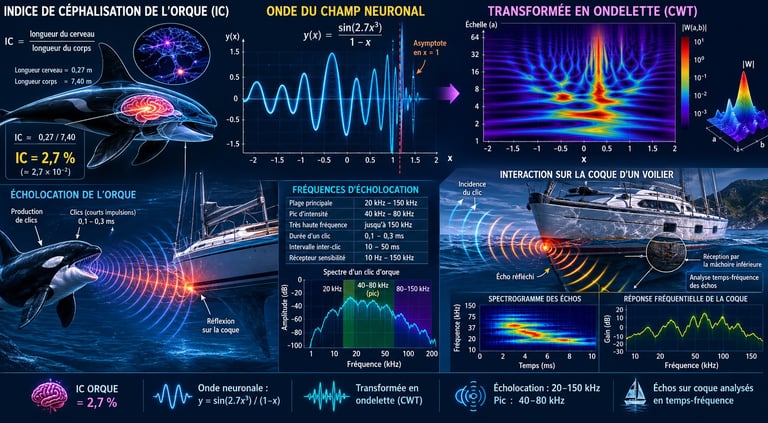
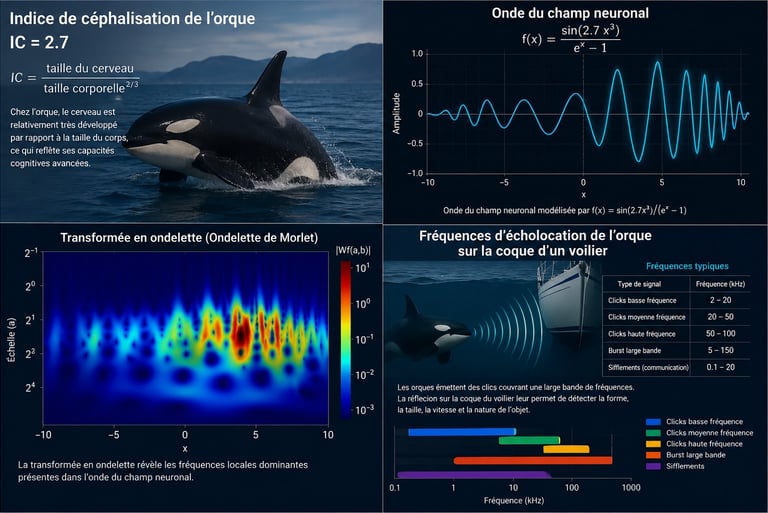
The Orca (Orcinus orca) possesses a highly developed brain weighing 5.4 to 6.8 kg, with an average cephalization index of 2.7. They possess an exclusive para-limbic lobe that facilitates sociability and communication, deeply integrated with their visual and echolocation capabilities. Stimulation of the hypothalamus triggers deleterious behavior toward sailboats, causing orcas to attack hulls and rudders as if they were prey. This is a learned, socially reinforced behavior among Iberian orcas that provides no energetic benefit, serving only to strengthen their social cohesion.
Acoustic Mitigation Strategies
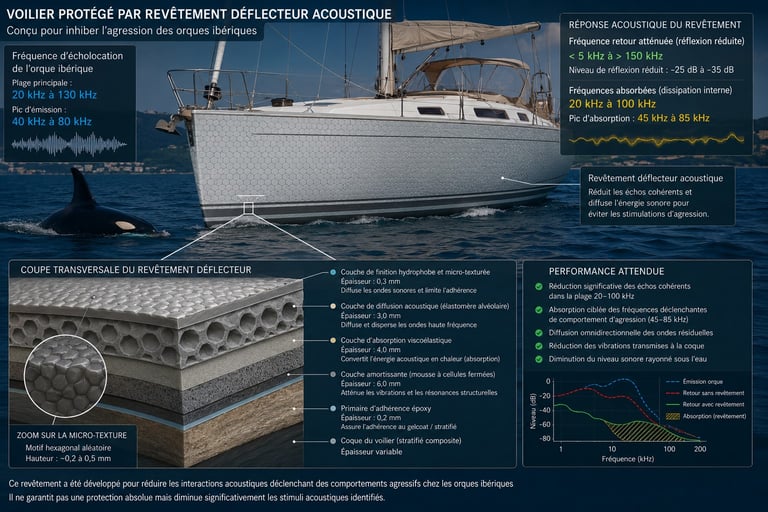
To protect vessels without harming the orcas, the goal is to reduce a boat's passive sonar signature and limit acoustic interest. Orcas use echolocation clicks primarily between 20 and 100 kHz, sometimes exceeding 150 kHz.
To make a vessel acoustically "invisible," the following structural modifications are suggested:
Applying absorbent elastomer coatings to reduce acoustic reflections.
Using high-damping composite materials and reducing flat reflective surfaces.
Optimizing rudder hydrodynamics and isolating bearing mechanics to reduce vibration.
Replacing traditional engines with electric propulsion, ducted propellers, or hydrojets to suppress cavitation.
The Towed Decoy Solution
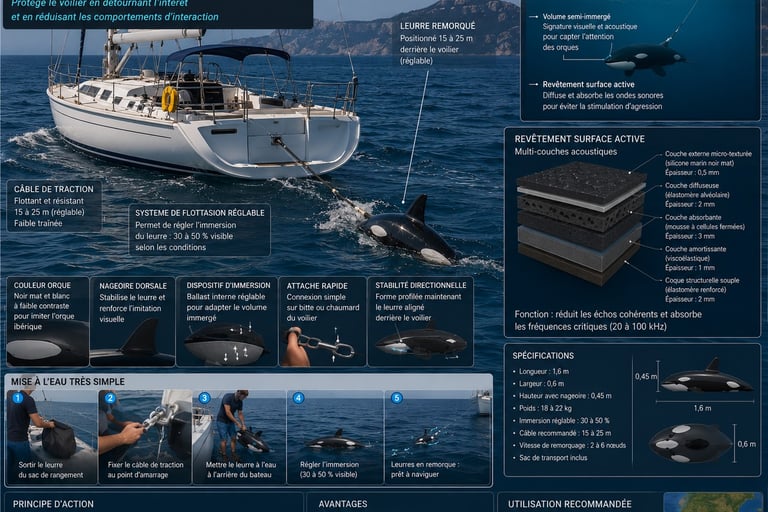
Because retrofitting existing hulls is difficult and unproven, a more realistic and immediate solution is a towed decoy. Designed to visually and acoustically mimic a juvenile Iberian orca, this device aims to divert attention and neurophysiologically inhibit aggressive stimulation.
Decoy Specifications and Usability:
The system requires no tools, deploying in under 3 minutes and recovering in under 2 minutes.
It consists of an inflatable, modular marine TPU body colored matte black and white to mimic an orca.
An adjustable water ballast allows the decoy to remain 30% to 60% submerged.
It is towed 10 to 20 meters behind the sailboat using a self-stabilizing Dyneema cable.
Three magnetic, clip-on acoustic bands actively absorb critical echolocation frequencies (20 to 100 kHz).
The entire kit is stored in a single bag, weighing between 7 and 9 kg for easy single-person handling.
Estimated Production Costs
Component Estimated Price Marine TPU Envelope
90 € Inflatable Bladder
30 € Ballast
20 € Detachable Fin
40 € Acoustic Bands
120 € Dyneema Cable
50 € Hardware / Fittings
Total Industrial Cost: Approximately 390 €